Field notes
Argolis Questions Answered: Canals, Kings and Tickets
Plain answers on visiting Argolis: what the Corinth Canal bridge is like, why Mycenae walls are called Cyclopean, and what entry tickets cost each season.

Guides to this corner of the Peloponnese tend to overflow with superlatives and thin on specifics, so the same practical questions keep reappearing in travel forums. Below are direct answers, gathered from the notes our Goldenlark Excursions leaders keep for the Argolis run. The region packs a healing sanctuary, a Bronze Age stronghold and the first capital of the modern Greek state into one small peninsula, and most confusion is about how these pieces fit together in a single day.
Why is Argolis considered so important?
The peninsula holds three of the most famous names in Greek prehistory and legend. Mycenae was the seat of Agamemnon, Tiryns the birthplace of Heracles, and Epidaurus the home of an ancient healing cult. In antiquity the Gulf of Argolis opened Greece to trade and ideas flowing from Crete and Egypt, which made the plain wealthy long before the classical era. The city of Argos gave the whole plain its name.
What is the Corinth Canal and can you walk over it?
Yes, and you should. The canal is a striking piece of 19th century engineering, cut through the narrow isthmus and finished by a French company in 1893. Walk to the middle of the old submersible bridge and you will feel it move, which alarms first-time visitors even though it has swayed for decades without incident. Periandros first imagined a canal here, but his era settled for a paved roadway that hauled boats across on rollers, a method used until the 13th century. The emperor Nero later tried digging by force and failed like everyone before him.
- Crossing the modern National Road, you will pass over the canal without seeing it.
- Leave the toll road for the old road, park at a cafe or tourist shop, and walk the footbridge.
- Bungy jumping from the bridge operates when conditions allow.
Is Argos worth stopping in?
It is a low-key agricultural town, and the absence of crowds is part of the appeal. The Roman remains include a giant amphitheatre, baths and an indoor theatre, and the Fortress of Larissa above it was enlarged by nearly every power that held the region, from the Byzantines through the Franks, Venetians and Turks. The Sanctuary of Apollo and Athena plus a Mycenaean necropolis sit within walking distance. A lively street market fills the main square on Thursdays, selling produce alongside clothing, antiques and household goods, and the town brewery, Zeos, was one of the first microbreweries in the country.
What makes the theatre at Epidaurus special?
Its acoustics, which are close to perfect. A whisper or a dropped pin at the orchestra can be heard from the top seats, a claim every guide demonstrates to its own amusement. The 3rd century theatre presented the tragedies of Aeschylus, Sophocles and Euripides until the 4th century BC, and performances resumed in 1955 with the Epidaurus festival, which runs from early July to the end of August each summer. The sanctuary honoured Asclepius, son of Apollo and the god of medicine whose serpent-entwined rod still marks the profession. A hospital once stood on the grounds, athletes competed in the stadium during the festival of the Asclepia, and poets read in the odeon whose ruins survive.
What is there to see at Mycenae?
Enormous walls and a famous gate. The stones are so massive that later Greeks assumed the giant Cyclops must have lifted them, which is how the term Cyclopean walls was born. You enter through the Lion Gate into a citadel that holds the palace of Agamemnon, the brother of Menelaus whose wife Helen was taken to Troy. Legend says his campaign against Troy took ten years, and that on his return his wife Clytemnestra murdered him in his bath, aided by a lover, before their son Orestes avenged him. The era from roughly 1600 to 1100 BC is named Mycenaean after this city, and several hotels and restaurants serve the modern village nearby.
Why do people love Nafplio?
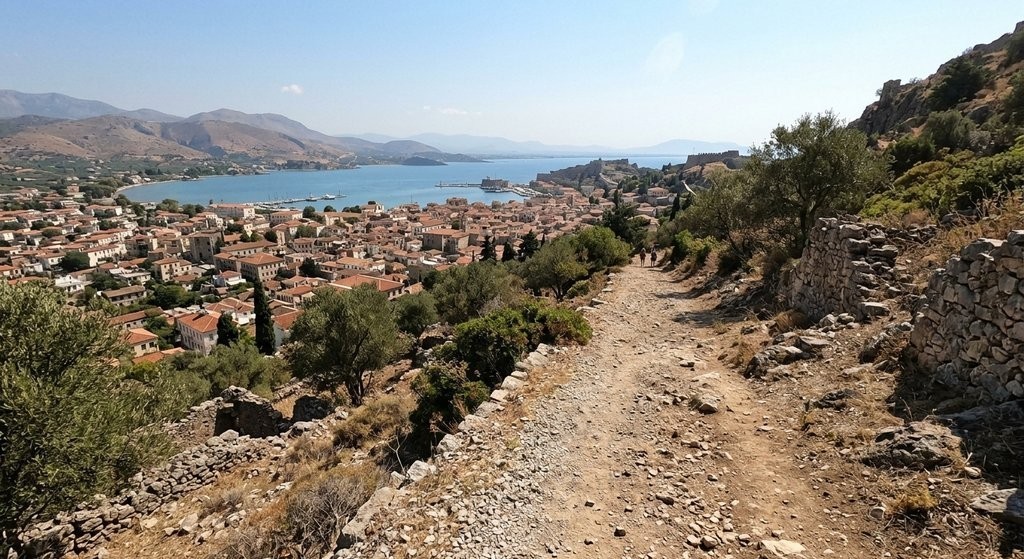
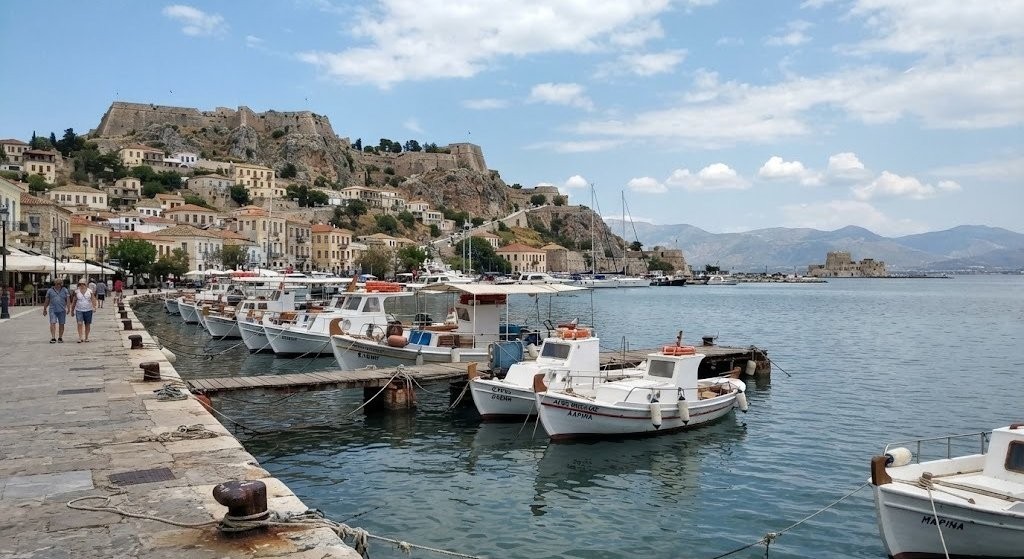
It is a port town of Venetian houses and classical mansions crowned by three fortresses: Palamidi, Akronafplia and the Bourtzi, the small island fort in the bay that serves as the town emblem. After the War of Independence it became the first capital of the new Greek state, when the country barely extended beyond the Peloponnese. Palamidi is really three fortresses in one, built by the Venetians in 1714 and seized by the Turks a year later. Waterfront restaurants, outdoor cinema, piano bars and cafes fill the evenings, and a folk music festival runs in late May and early June.
How many steps does Palamidi really have?
Counting depends on where you stop. Locals say 999 steps to the top of the castle, a number that appears on local menus as a joke aimed at visitors, while the winding stair from town to the fortress entrance has 913. Reaching the very top takes over one thousand steps in total. Climbers are rewarded with a commanding view over the Argolic Gulf, but the sensible option is to drive up to the entrance and save your legs for the ramparts.
What are the beaches and bases near Nafplio?
The resort town of Tolo plus the beaches of Karathona, Asini, Drepano, Plaka, Kadia and Iria are all close enough to fill your days. Nafplio works well as a base for reaching Epidaurus, Mycenae, Tiryns and the wider region, with direct buses to the capital. From nearby Hermioni, Porto Heli or Galata you can catch a hydrofoil to Spetses, Hydra, Poros or Aegina and return to Piraeus.
Is Palea Epidavros worth a stop?
The old port town is famous for its citrus groves, and in winter and spring the air smells of orange blossom as you arrive. A small ancient theatre was found in the backyard of a house here and is still being excavated, along with other buildings in the neighbouring olive grove. The square holds fish tavernas supplied by the local fleet, and the waterfront cafes make it a pleasant coffee stop or even a one or two day base for exploring the peninsula.
What do the entry tickets cost?
Both Epidaurus and Mycenae charge 12 EUR full price from April to October and 6 EUR from November to March, with a reduced rate of 6 EUR. A combined 20 EUR ticket covers Mycenae with its site, museum and Treasury of Atreus, plus Tiryns, Asini, Palamidi, the Nafplio Museum and the Byzantine Museum of Argos, and it stays valid for three days from issue.
- 6 March, in memory of Melina Mercouri.
- 18 April, International Monuments Day, and 18 May, International Museums Day.
- The last weekend of September each year, and 28 October.
- Every first Sunday from 1 November to 31 March.
The question that should shape your plan is not which site is grandest but which single base lets you see them all: Nafplio answers it, sitting within an hour of everything listed above and paying you back each evening with its waterfront.
Written by the Goldenlark Excursions team. Routes are checked on the ground and pages are edited in place when something changes. Spotted an error? Tell us and we will fix it.
Next step
Let us plan the next one
A short brief is enough. We reply with questions, a route sketch and what it would cost before you commit to anything.